
Originally called Cape Newagen Island, Southport as a settlement first appears in local histories as early as 1623 when Christopher Levett mentions the island in his brief history. Levett found a well established fishing and trading community there in 1623. The Island had originally been inhabited by Indians.

A hundred years later in the 1720s, a British officer and adventurer, Col. David Dunbar, seeking to supply the royal demand for tall pine masts, set up his headquarters at Fort Pemaquid. From there he established settlements of Scotch-Irish countrymen in several coastal sites including Boothbay, an area then called Townsend. Harried incessantly by Indian attacks, peace came to the Townsend settlement in 1763.
The Town of Boothbay was incorporated in 1764 and a Presbyterian Church was founded in 1766 served by the dynamic Scots-Irishman preacher John Murray. Southport churchgoers rowed or sailed the three miles to Sawyers Island, then walked the mile and a half to worship at Murray’s Boothbay Center church. During the 1770s Boothbay patriots swept the region into the vortex of the American Revolution. British men-of-war patrolled the area, and Murray’s own patriotic actions forced him to flee to New Hampshire.
By the end of the revolution the nucleus of a small community existed on Southport. David Nelson built a tidal gristmill and sawmill in 1782 on the banks of the cove now known as West Southport Lobster Pound. Captain Jonathan Pierce opened a general merchandise store located in Hendricks, now Cozy Harbor.

Forty years later, the young federal government, anxious to promote lively coastal and trans-Atlantic maritime trade, established a light station on Burnt Island. It remains one of the nation’s oldest on the East Coast. A few years later in 1829 the government approved an expenditure of five thousand dollars to erect another lighthouse at Hendricks Head.
Cape Newagen’s ground fishing economy flourished in the half century before the American Civil War. By 1842 the island’s population had grown sufficiently that the townspeople separated from Boothbay, incorporated the town as Townsend, and held the first town meeting. The name was later changed from Townsend to Southport.
In 1860 Southport reported 59 schooners fishing the Grand Banks, and, according to Francis B. Greene’s History of Boothbay, Southport, and Boothbay Harbor, Maine (1906) “no town in Maine made its own business and earned so many dollars per capita as Southport.” It was, as well, dangerous business; thirteen Southport fisherman were lost in the terrible Atlantic gale of 1851.

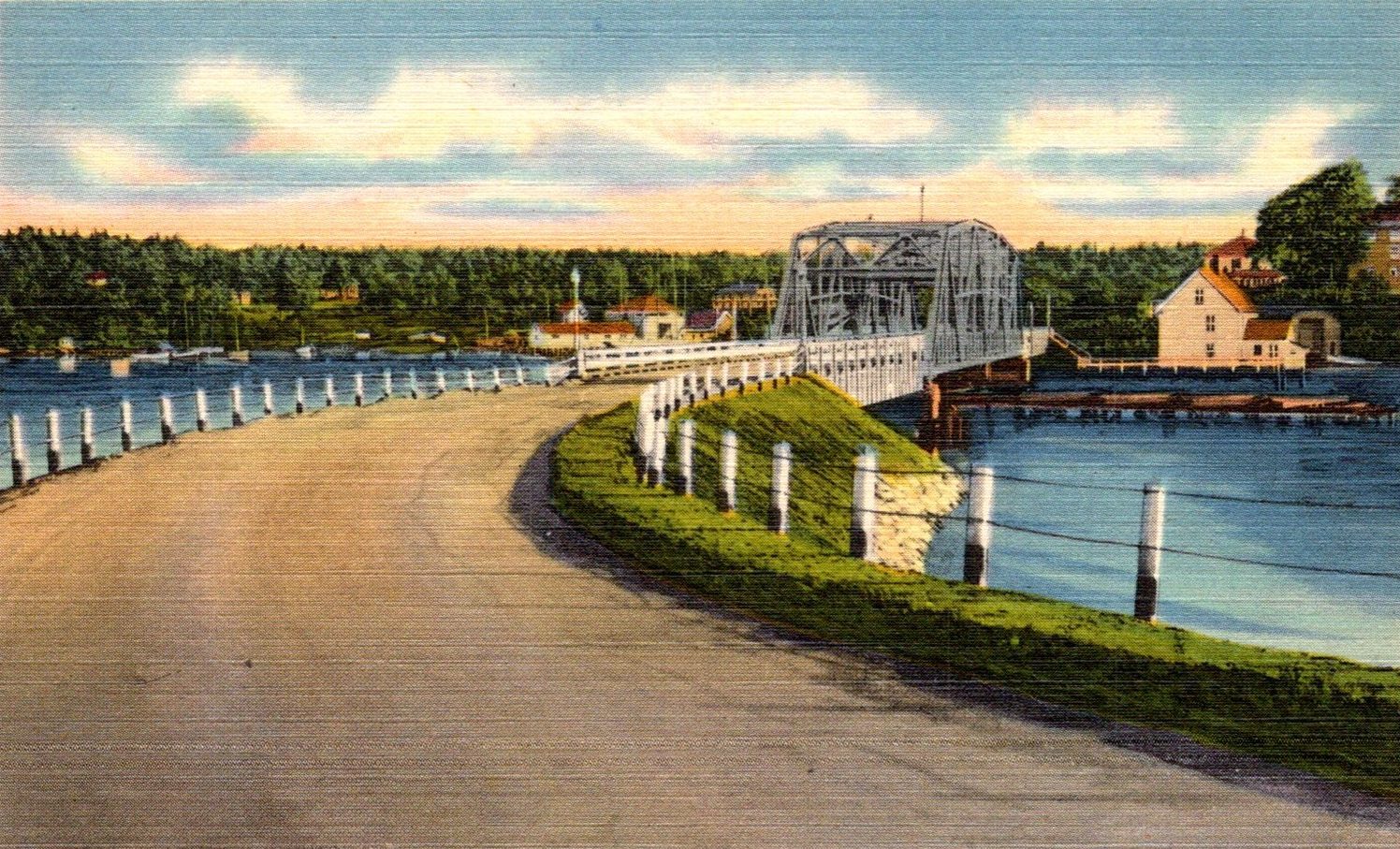
Following the Civil War, in which thirty-three Southporters served, the island’s population continued to grow, but the fortunes of its once flourishing fishing economy – like Maine’s maritime economy as a whole – waned. In the late 1860s a joint-stock company of local businessmen invested in a toll bridge connecting the town to the mainland, and Southport commenced serving a growing number of summer visitors – many of whom arrived aboard steamships from Boston and Portland.
An ice field driven by a northwest gale destroyed the wooden toll span in 1871. Another span did not replace it until 1896; meanwhile, a ferry service operated at the site. In 1896 the town built a new wooden bridge at the present crossing. During the post-Civil War decades, steamship docks, boarding houses and several large hotels dotted the landscape. J.B. Ham purchased Squirrel Island for $2,200 in 1870; this summer retreat was shortly incorporated as a village within the jurisdiction of Southport. The Gray Colony opened in 1873 on the east shore, the first, oldest and largest of the early summer hotels. By the 1880s, in addition to the Gray Community other such colonies of family-owned cottages appeared at Pine Cliff, Cape Newagen, Dogfish Head, and Capitol Island.
At the turn of century technological “progress” brought inexorable change to the island. Between 1892 and 1907 several “modern” inventions altered the Southport way of life. In 1892 the U.S. Government built a fog signal at Cuckolds. A light was added later. Telephone service arrived in 1897 followed by electricity in 1911. Despite Edison’s invention, gas and kerosene lighting remained a mainstay for years to come. In the second so-called “roaring” decade of the twentieth century Southport established a water system, and in 1927 founded a volunteer fire company and converted the old school into a firehouse.
While ground fishing and lobstering continued to buttress the island economy in the 1920s, the arrival of the automobile deepened Southport’s image as a summer colony. More summer houses – now often built for rental not family ownership as in the 1880s – arose in places such as Pratt’s Island. These rental cottages added to the existing population of summer people residing in the more traditional hotels, boarding houses, and colonies. The new summer economy caused a correlative spike in the year-round population. Between 1920 and 1930 Southport’s population rose 51% from 272 to 412. With the growth in 1920’s cottagers came an interest in motor boating. Indeed, it was to encourage motorboat racing on the Sheepscot River that in 1923, spurred by Earl W. Pratt, Sr. owner of Pratt’s General Merchandize store and pavilion, the Southport Yacht Club was founded in Cozy Harbor. The same year a bridge was built to Pratt’s Island.